Showing posts with label Theme: Rock Hounds. Show all posts

Wednesday, 6 November 2013

Cub Scout Pack Meeting: November 6, 2013

DATE: November 6, 2013
Theme:    Cooperation                                                                   Objective: _______________________________
                                                                                                                                     _______________________________
Attendance Assignment: _________________                               Spiritual Thought Assignment: ___________________
TIME
ACTIVITY
EQUIPMENT NEEDED
BADGE REQUIRMENTS MET
PACK MEETING ADGENDA
5:00
Display  
Show projects from previous weeks

5:05
GAMES:

BUSINESS:
-Badge worksheets
-Date for Investiture


Brief Outline of Business
Upcoming dates to mark on calendar.

5:15
RECOGNITION:
     - This month’s theme – Rock Hounds
     - Certificates
Assignment Sheets
Certificates
Geodes

5:25
SPIRITUAL THOUGHT:


5:27
WRAPUP PACK MEETING:
-Handout detailed calendars for upcoming month
-Badge worksheets for at home work
-Pertinent information to upcoming activities
CLEAN UP & SEND EVERYONE HOME
Calendars
Badge worksheets


3:45
Gathering Activity: I Spy
     -
Rockhound Poster
List of I Spy Items

4:00
Opening Ceremony
     -Opening Prayer: _____________
     -Attendance: ________________
     -Welcome/Introduction
Attendance Sheet


4:05
GAME: Camouflage


4:15
BADGEWORK: Animals in Winter

Books to  read and discuss
Naturalist #5 p. 47
4:25
THEME ACTIVITY: Camouflage

You Tube videos
Naturalist #4 p. 47
4:45
GAME:


4:55
Set up for Pack Meeting
Hand out assignments for Pack Meeting


Gathering Activity: I Spy

Materials:
·         Rockhound Poster
·         List of hidden items
Give each boy a list and see who can find everything the fastest

Game: Camouflage

To set up the game for playing the first time- ask what predator and prey mean. Have your children pick a local predator (for example a fox), then pick something it would eat for dinner (rabbit). What does the prey do to get away from a predator? They usually run and hide or simply stop and freeze.
 To play the game-     
·         Tell the children you are going to randomly yell out “camouflage”
·          Yell ”CAMOUFLAGE,”  then count to five, the children have five seconds to camouflage in with their environment or freeze.
·         Open your eyes on five. Anyone you see moving is dinner.
·         Anyone not moving is camouflaged and you do not see them- even if they are standing right in front of you. So, as long as they are not moving they are not seen. Call out anyone you see moving and tell everyone else good job and come on out.  

Game: Predator/Prey

1. Find an area with big trees, downed logs, brush, or tall grass.  Avoid water, thorns, and poison ivy.
2. Pick someone to be IT.  IT must choose a location to stand for the duration of the game.  IT can lunge and pivot in their spot but they cannot walk away in any direction.
3. Everyone else (players) start with a finger touching IT’s arms.
4. Round One (20 second round)- IT closes their eyes and counts loudly to 20.  Players run and find a hiding spot among the surroundings.  Players can run as far as they can in 20 seconds as long as they can still hear IT counting.  At 20 seconds, IT opens their eyes and immediately searches for players (remember IT cannot move from their spot).  Players are out if IT visually spots them or their clothing.  Spotted players are out for the duration of the game and must wait off to the side.  When IT cannot find any other players move to round two.
5. Round 2 (15 second round)- IT closes their eyes and counts loudly to 15 seconds.  Players still in the game must move closer to IT and find a new hiding spot.  After 15 seconds, IT opens their eyes and searches for players in the same manner as round one.  When IT cannot find any more players move to round three.
6. Round 3 (10 second round)- round 3 is played exactly the same as round two.  Remaining players have 10 seconds to move closer to IT.  When IT cannot find any more players move to round four.
7. Round 4 (Ready Set Go round)- IT yells “Ready Set Go!”  Any players still hiding race to tag IT.  The first person to tag IT is the winner.

How to win: Be the last person hiding when all other players are out OR be the first person to tag IT in the Ready Set Go round.
Additional Rules: Players MUST move closer to IT at the start of each new round.  If players do not move or do not move closer, they are out.
Players who are out cannot tell IT where to look for other players (that’s cheating!)
IT may get people out by identifying their clothing- “Red sleeve and jeans behind the tree” is a legitimate way to get someone out even if IT does not know the person’s name.  In fact, identifying clothing is encouraged so that IT is not just calling out players’ names to lure them out of hiding.
Hints for IT: Be patient.  Impatient players will peek out of their hiding spots to see how the round is progressing.
Hints for Players: Don’t hide behind the closest tree during round one- you will have nowhere to move closer in the next rounds. Conversely, don’t hide behind the furthest tree either- you will never make it back in time for the Ready Set Go round. Be patient.  IT will see you if you peek out from behind your hiding spot.

THEME ACTIVITY: Camouflage Animals

Camouflage
Watch the Camouflage YouTube video 


Study camouflage pictures and identify hidden animals
Watch 2 camouflage videos: Leopard Camouflage, Ultimate Camouflage


Discuss the different ways that animals camouflage from danger?

Badgework: Animals in Winter

Materials Needed for Each Boy:
·         Animals in winter Book
Read the book to the cubs and then discuss how at least 3 different animals survive in the Canadian winter.


Tuesday, 15 October 2013

Cub Scout Den Meeting: October 16, 2013

    DATE: October 16, 2013    
Theme:    Rock Hounds                                                                 

TIME
ACTIVITY
EQUIPMENT NEEDED
BADGE REQUIRMENTS MET
3:45
Gathering Activity:  Lets Rock and Roll
Picture
Crayons

4:00
Opening Ceremony
     - Opening Prayer: _____________
     - Grand Howl
     -Attendance: ________________
Attendance Book
Stamp and Ink

4:05
GAME:  Wolf’s Dinner Time


4:15
BADGEWORK: Law of the Wolf Cub


Law Awareness #1
Law Awareness #2
4:20
THEME ACTIVITY: Rock Collection

Foam boards
Rocks
Glue Gun and Glue
Black Marker
Ruler (meter stick)
Black Star 2A
4:40
GAME:  Lava Rock
A rock that can be passed without danger of hurting anyone

5:00
THEME ACTIVITY: Water Cycle


Black Star 10A
5:10
BADGE WORK:  


5:15
SPIRITUAL FELLOWSHIP
     -Spiritual Thought: ____________
Assignment:

5:20
Closing Ceremony
     -Cub Promise (review line 2)
     -Closing Prayer
     -Badge worksheets or other information


5:30
Dismiss and Go Home


GATHERING ACTIVITY:  Lets Rock and Roll

Color the rocks in the picture.


GAMES: Wolf’s Dinner Time

Materials:


        Outdoor play area or large indoor area


How to Play:
·         One player becomes the wolf and he/she will stand with his/her back turned to the others about 15 feet from the others. The others call out, "Whats the time Mr. Wolf" and the wolf turns to face the others and shouts out a time. Eg: 9 o'clock. The others would then take 9 steps toward the wolf. The group will take the same amount of steps toward the wolf as the amount of hours in the wolfs time. eg, 4 o'clock = 4 steps, 6 o'clock = 6 steps etc. etc. The wolf will then turn his back to the group again for them to yell "whats the time...." (He looks at the group only when he shouts the time at the group").
·         When the group comes close to the wolf the next time the group yells "whats the time Mr. Wolf" the wolf will say 'Its DINNER TIME" and run after the group who are running back to the start line, and hopefully catch one of the group who will then be the wolf. It sounds noisy, but is an interesting game.

GAMES: Lava Rock

Materials:


        Rock
        Music
How to Play:
Have the Cubs sit in a circle. Start the music and have them pass the ‘lava’ rock as though it were molten lava. When the music stops, the Cub who is holding the ‘lava’ leaves the circle. Go until there is only one Cub left!


THEME ACTIVITY: Rock Collection

Materials Needed:
q  Foam board
q  Glue gun and glue sticks
q  Black marking pen
q  Information on rocks for categorizing
q  Rock Collection


Have the boys sort their rocks into 4-6 different groups on the table. Sort rocks according to color, size, texture or element. Have them glue their rocks to the foam board provided to display their collection. Give each boy 1 minute to explain to the pack why he organized his collection the way he did.


BADGEWORK: Law Awareness


What rules should we have in our pack? What might happen if we didn't have rules?
Who makes the laws in our country? Why are these laws important to you?
Who is responsible for making sure that these laws are followed? Who can you ask for help if you see a law being broken?


THEME ACTIVITY: Water Cycle

Materials Needed:


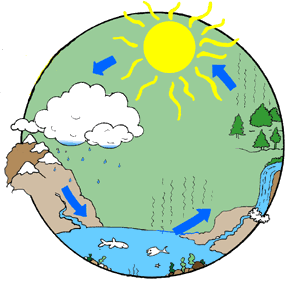
q  Watercycle diagram
q  River Basin diagram and information for our area
q  Alberta map
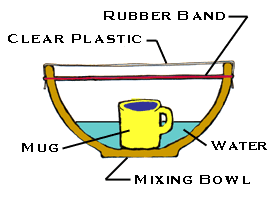
q  a large metal or plastic bowl
q  a pitcher or bucket
q  a sheet of clear plastic wrap
q  a dry ceramic mug (like a coffee mug)
q  a long piece of string or large rubber band
q  water


Put the bowl in a sunny place outside.

Using the pitcher or bucket, pour water into the bowl until it is about ¼ full.
Place the mug in the center of the bowl. Be careful not to splash any water into it.
Cover the top of the bowl tightly with the plastic wrap.
Tie the string around the bowl to hold the plastic wrap in place.
Watch the bowl to see what happens.
The "mist" that forms on the plastic wrap will change into larger drops of water that will begin to drip. (You can speed up the dripping by carefully moving the bowl – don't splash! – into the shade.) When this happens, continue watching for a few minutes, and then carefully peel back the plastic. Is the coffee mug still empty? Water from the "ocean" of water in the bowl evaporated. It condensed to form misty "clouds" on the plastic wrap. When the clouds became saturated it "rained" into the mug!

 south Saskatchewan river basin • The South Saskatchewan River basin includes the sub-basins of the bow, red Deer, Oldman, and south Saskatchewan river basins. All of the sub-basins begin in the Rocky Mountains, generally flowing eastward through the foothills and prairie. the combined area of the sub-basins is 121,095 km2, of which 41 per cent comes from the red Deer, 22 per cent the Oldman, 21 per cent the bow, and 16 per cent the South Saskatchewan. Major urban centers in the basin include Calgary, Lethbridge, red Deer, and Medicine Hat. All of the province’s thirteen irrigation districts are found in the South Saskatchewan River basin. The mean annual discharge from the basin into Saskatchewan is 9,280,000,000 m3

Tuesday, 8 October 2013

Cub Scout Den Meeting: October 9, 2013

    DATE: October 9, 2013    
Theme:    Rock Hounds                                                                 

TIME
ACTIVITY
EQUIPMENT NEEDED
BADGE REQUIRMENTS MET
3:45
Gathering Activity:  Rock Jokes


4:00
Opening Ceremony
     - Opening Prayer: _____________
     - Grand Howl
     -Attendance: ________________
Attendance Book
Stamp and Ink

4:05
GAME:  Mini Olympics
Skipping
Long Jump etc
Athletic Badge #4
4:15
BADGEWORK: Insect Habits: An introduction to insects

First Aider #2i
WSEA Natural Habitat 1c
4:20
THEME ACTIVITY: Discovering Insects in our Backyard

Magnifying glass
Observation worksheets
Pencils and clipboards
Observer badge #5
4:40
GAME:  Rock Slide Cruise


5:00
THEME ACTIVITY: How Trees Grow
Discuss why trees are important.
Yarn
Cardstock
Glue
Black Star 5A
5:10
BADGE WORK:  Identify 6 trees or shrubs
Identification Worksheets
Leaves to identify
Observer Badge #6
5:15
SPIRITUAL FELLOWSHIP
     -Spiritual Thought: ____________
Assignment: Story from the Friend

5:20
Closing Ceremony
     -Cub Promise (review line 2)
     -Closing Prayer
     -Badge worksheets or other information


5:30
Dismiss and Go Home


GATHERING ACTIVITY:  Rock Jokes

Have boys tell each other jokes about rocks.
  1. What does a rock want to be when it grows up? 
  2. What do you call a dog who collects rocks? 
  3. What do you do to a baby rock? 
  4. What is a rock's favorite kind of music? 
  5. Where do rocks sleep? 
  6. How do rocks wash their clothes? 
  7. What is a rock's favorite transportation? 
  8. What is a rock's favorite cereal? 

Answers

1.       A Rock Star 
2.       A Rockhound 
3.       Rock it 
4.       Rock 'N Roll 
5.       Bedrock 
6.       On the rock cycle 
7.       A rocket 
8.       Cocoa Pebbles 


GAMES: Mini Olympics


Have the boys continue with last week’s activities

GAMES: Rockslide Cruise

This game is played like red light – green light. Instead when the word cruise is said the boys can run. When the word rockslide is said the boys have to stop. Anyone moving after the word rockslide hast to go back to the beginning.

VARIATION: To make this game a little more interesting, create a circuitous path that they must follow rather than running straight for the end of the play area.

THEME ACTIVITY: Insects in our Backyard

Materials Needed:


          Insect identification chart
          Insect Observation Worksheet
          Plastic spoon
          2 Plastic cups (Petri dishes, lidded plastic containers, sample bottles, etc.)
          Magnifier box, or hand lens
          Digital Camera if desired


OVERVIEW
Have each Cub Scout search out as many different insects as he can. Have him identify each insect he finds and write it down.

PREPARATION
Before doing this activity, we recommend you make sure the boys understand basic insect anatomy to help them recognize and differentiate insects from other organisms, and to help them appreciate some of the major groups of common insects.
Your location could be outside the door in the building you meet in, or it could be a nearby municipal park, or it could be a more remote natural area. In any case, pick out and mark several different spots where Cubs  will be able to find insects
Here are some suggestions for different locations:

 • Under a log
 • Near or under rocks or gravel
 • In a grassy spot in full sunlight
 • At the base of a tree
 • In the leaf litter on the forest floor
 • In the leaves an blossoms of a flowering plant
 • On the trunk and branches of a tree
 • Near the wall of a building
 • On or near a sidewalk
PROCEDURE
Step 1: Equip your pack with simple insect capture and observation tools, a clipboard, a pencil, and a worksheet, as listed above.
Step 2: Assign each pair of boys to two locations where they will hunt for and observe insects. Instruct them to handle the insects very carefully, and if the insects are too fast or vigorous, to leave them alone.
Step 3: Be sure the boys are recording their findings on their observation worksheet. Gather the pack after 6 insects have been identified and observed.

Fun Facts About Insects and Bugs

          Night butterflies have ears on their wings so they can avoid bats.
          Monarch caterpillars shed their skin four times before they become a chrysalis, growing over 2700 times their original size.
          There may be as many as 3,000 different kinds of insects — more than all the other animal and plant species combined.
          Of the huge numbers of insects, only a tiny amount, one percent, are harmful to humans. Most insects are harmless or actually beneficial. For example, without bees to pollinate flowers, plants would not have a way of reproducing and we wouldn’t have anything to eat!
          Locusts can eat their own weight in food in a day. A person eats his own body weight in about half a year.
          The earliest fossil cockroach is about 280 million years old ~ 80 million years older than the first dinosaurs!
          The desert locust is the world’s most destructive insect. It can eat its own weight in food every day. Large swarms can gobble up to 20,000 tons of grain and plants in a day.
          The honeybee has to travel an average of 43,000 miles to collect enough nectar to make a pound of honey!
          Out of every 1,000 Mosquitos, one female carries a disease that could be fatal to humans.
          Honeybees have hair on their eyes.
          The average housefly lives for one month.
          There is only one insect that can turn its head — the praying mantis.
          A slug has four noses.
          Some male spiders pluck their cobwebs like a guitar, to attract female spiders.
          A mosquito flaps its wings 500 times a second.
          Only male crickets can chirp.
          Baby robins eat 14 feet of earthworms every day!
          About 80% of the Earth’s animals are insects!
          The common garden worm has five pairs of hearts.
          Dragonflies can fly up to 50 miles per hour.
          The earliest fossil cockroach is about 280 million years old – 80 million years older than the first dinosaurs!
          The praying mantis is the only insect that can look behind its shoulders.
          One kind of insect called a spittlebug, lays its eggs in a big nest of saliva bubbles. I guess no predator would look for a meal in there!
          A snail can sleep for 3 years straight!
          The heaviest insect in the world weighs 2.5 ounces.
          A cockroach can live for up to 3 weeks without its head!
          A butterfly has its taste receptors in its feet!
          The mayfly only lives for 8 hours!
          The female black widow’s poison is 15 times deadlier than a rattlesnake’s!
          There are worms in Australia that are over 4 Feet Long!
          The weight of all the termites in the world outweigh the weight of all humans 10 to 1!


THEME ACTIVITY: How Trees Grow Craft

Materials Needed:


q  Green yarn
q  Brown yarn
q  White yarn
q  Red yarn
q  White glue
q  Cardstock


Give each Cub a piece of cardstock divided into 6 sections. Have them label each section respectively: Seeds, Sprouts, Seedling, Tree, Blossoms, Apples

Use the worksheet below to help conduct a discussion about why trees are important in nature.


BADGEWORK: Identifying Trees/Shrubs


Materials Needed:
·         Leaves gathered from various varieties of trees.
·         ‘A Key to Trees’ Worksheet
·         Pencils