Showing posts with label Theme: Exploration and Discovery. Show all posts

Tuesday, 4 November 2014

Cub Scout Pack Meeting - November 5, 2014


DATE: November 5, 2014
Attendance Assignment: _________________                               Spiritual Thought Assignment: ___________________
TIME
ACTIVITY
EQUIPMENT NEEDED
BADGE REQUIRMENTS MET
3:45
Gathering Activity:
     -


4:00
Opening Ceremony
     -Opening Prayer: _____________
     -Attendance: ________________
     -Flag Ceremony
     -Welcome/Introduction
Attendance Sheet


4:05
GAMES:

BUSINESS:


Brief Outline of Business
Upcoming dates to mark on calendar.

4:15
RECOGNITION:
     - Report of the activities of the last two months
     - Certificates
Assignment Sheets
Certificates

4:25
CUBMASTERS MINUTE:


4:27
WRAPUP PACK MEETING:
INVITE PARENTS TO STAY IF THEY WISH
Calendars
Badge worksheets


4:30
GAME:


4:40
THEME ACTIVITY: Periscopes


Tawny Star A7
5:05
GAME:


5:15
SPIRITUAL FELLOWSHIP
     -Spiritual Thought: ____________
Assignment on assignment sheet

5:20
Closing Ceremony
     -Grand Howl
     -Flag Ceremony
     -Closing Prayer
     -Badge worksheets or other information


5:30
Good Night and Good Hunting


 THEME ACTIVITY: Periscopes 

Making Periscopes
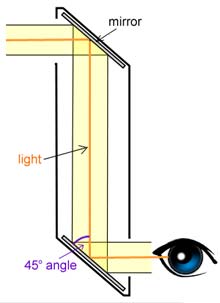
A periscope lets you see over the top of things, such as fences or walls that you aren't tall enough to look over. You can also use it to see around corners.

People first started using periscopes in submarines in about 1860, to allow the sailors to see above the water. Later, soldiers in the First World War used them to look out of the trenches without having to put their heads out of the trench. Periscopes are still used today in tanks and some submarines.

how a periscope works
A simple periscope is just a long tube with a mirror at each end. The mirrors are fitted into each end of the tube at an angle of exactly 45 degrees (45°) so that they face each other.

In the periscope, light hits the top mirror at 45° and reflects away at the same angle. The light then bounces down to the bottom mirror. When that reflected light hits the second mirror it is reflected again at 45°, right into your eye. You can see this in the picture on the right.

Light is always reflected away from a mirror at the same angle that it hits the mirror.

We made our own periscopes using sheets of cardboard and small mirrors.

How to make a Periscope

See: http://www.webinnate.co.uk/science/week8.htm

Wednesday, 20 November 2013

Cub Scout Den Meeting: November 20, 2013

    DATE: November 20, 2013    
Theme:    Our Natural World                                                      

TIME
ACTIVITY
EQUIPMENT NEEDED
BADGE REQUIRMENTS MET
3:45
Gathering Activity:  Astronomy Word Search
Word Search
Pencils

4:00
Opening Ceremony
     - Opening Prayer: _____________
     - Grand Howl
     -Attendance: ________________
Attendance Book
Stamp and Ink

4:05
GAME:  Meteorite Madness


4:15
BADGEWORK: Constellation Story


4:20
THEME ACTIVITY: Dying with Natural Fibers

Onion dye extracted from onion skins
T shirts
Naturalist #2
4:40
GAME:  Big Truck Relay


5:00
THEME ACTIVITY: Peromones


Naturalist #9
5:10
BADGE WORK:  Astronomy

Black Star 11A
Astronomer #1,#3
5:15
SPIRITUAL FELLOWSHIP
     -Spiritual Thought: __Jamie__________
Assignment: Tell how Heavenly Father answers your sincere prayers.

5:20
Closing Ceremony
     -Cub Promise (review line 2)
     -Closing Prayer
     -Badge worksheets or other information


5:30
Dismiss and Go Home


GATHERING ACTIVITY: 

Word Search


GAMES: Meteorite Madness

Materials:


•        Medium sized rocks to serve as meteorites
•        2 jump ropes


Set Up:


·         Gather the suggested items.
·         Take one jump rope and make it as lay it on the ground as big as you can in a circle to serve as the Earth's atmosphere.
·         Use the second jump rope to make a smaller circle inside the other first to serve as the actual Earth.
·         Guide the game.

How to Play:
·         Astronomy games such as this Meteorite Madness can help children learn the difference between the some of the confusing cosmic terminology. Players take turns using hand eye coordination to try to toss a 'meteor' (rock) to Earth to score the most points. When a player throws their meteor, ask them what they think they created; a meteor(which only goes through the Earth's atmosphere), meteorite( which lands on the Earth's surface) or meteoroid (which stays in space). If they get the answer wrong, their points for the throw get cut in half but if they get it right, they get awarded the full point value for their throw.

·         Meteoroids - Landing outside of the circles (in space) = 5 points
·         Meteors - Landing inside the outer circle (Earth's Atmosphere) = 10 points
·         Meteorites - Landing inside the smallest circle (Earth's Surface) = 20 points

·         Whatever player has the most points at the end of the game wins!

GAMES: Big Truck Relay

Materials:


•        Pillows and stuffed animals
•        Laundry Basket
•        Stopwatch if desired


How to Play:
Have players move a pile of soft objects (like pillows and stuffed animals) from one spot in the room to another. To move, players must crawl on their hands and knees with the “load” piled on their backs. Assign each “truck” a laundry basket that the load must be dumped into. Any items that land of the floor don’t count–only the ones that make it into the basket!!

THEME ACTIVITY: Dying with Natural Fibers

Materials Needed:


q  Onion Skins – the more the better – water to cover
q  Aluminum Pot
q  T Shirts


Bring the water to a boil and let simmer for an 1 hour
Remove the onion skins from the pot (I suggest using a colander)
Soaking the dyestuff a few days before is an alternative or aid in extracting color from dyestuff
Evenly soak fibers in hot water before placing them in the dyebath (this helps achieve even color)
Place pre-wet fibers into the dyebath
Heat dyebath for 1 hour, using a spoon or stick to submerge fibers and free air bubbles
To achieve even color avoid crowding the dyepot
Let the fibers cool in the dyebath this will give brighter results
Most dye artist let the bath sit and cool overnight or even a few days, longer is stronger
Remove the fibers from dyebath, rinse with cold water until water runs clear
Hang to dry.

BADGEWORK: Astronomy


Show pictures of stars and constellations. Have the cubs identify constellations that they see using the chart below.


THEME ACTIVITY: Pheromones

Materials Needed:


q  YouTube video:  Honey Bees – Natural History – 1 (http://www.youtube.com/watch?v=x7cX2cjFunw&list=WLE97043FA9C2D013E)
q  YouTube video:  Animal Communication (http://www.youtube.com/watch?v=LsMbn3b1Bis&list=WLE97043FA9C2D013E)
q  Nature Works: Chemical Communication (http://www.nhptv.org/natureworks/nwep3d.htm)


Watch videos and discuss with cubs how animals communicate using scent using the pdf Nature Works document

BADGEWORK: Constellation Story

Materials Needed

- Orion

The Hunter

The ancient Greeks gave us a lot of great stories – many of them very different from each other. One might say that Orion was a great hunter who was banished to the sky for bragging on how many animals he could kill and the two bright stars which follow him represent his hunting dogs. Another says Orion fell in love with a goddess and was killed by an arrow when the goddess’ brother was tricked into shooting him. Still another says he was killed by a sting from Scorpio, the Scorpion. No matter which tale you may care to listen to, the fact remains that cultures all over the world have recognized this constellation for centuries on end and all see Orion as a human figure. But why would they notice this constellation more than any other? Maybe it’s the magic that’s just below those three stars!
If you live where the skies are dark, you’ll see another line of stars just below the trio. In myth, this represents Orion’s “sword”, but it’s a magic one. Take a close look and you’ll see a ghostly glow just about in the center of the sword. If you don’t spot it with your eyes alone, try using a pair of binoculars. It will look like a glowing cloud for a very good reason. It’s a cloud where stars are being born! This glowing gas cloud is called the Great Orion Nebula and the light you see now left on its journey to your eyes around 500 A.D. That’s about the time that King Arthur was around! Inside are hundreds of stars being born and their energy lights up the gas, just like a neon tube. While you won’t see the pretty colors with your eyes the way the camera does, you can still enjoy the magic and share what you’ve learned with your friends. All you need to do is just find three stars in a row…


Tuesday, 29 October 2013

Cub Scout Den Meeting: October 30, 2013

    DATE: October 30, 2013    
Mini Day Camp

TIME
ACTIVITY
EQUIPMENT NEEDED
BADGE REQUIRMENTS MET
3:45
Gathering Activity:  


4:00
Opening Ceremony
     - Opening Prayer: _____________
     - Grand Howl
     -Attendance: ________________
Attendance Book
Stamp and Ink

4:05
Travel to Adventure Area


4:20
BADGEWORK: Bird watching: Recognize and describe habits of 6 birds.


Observer #2
4:35
BADGEWORK: Bird calls

Straws
Scissors
Observer #3
4:45
BADGEWORK: SEEDS
1. Different kinds of seeds - travel by helicopter, parachute, sling shot, hitchhiker, animal express. Discuss how seeds are dispersed


Naturalist #1
4:55
BADGEWORK: Observation
Go for a walk and discuss the following points:
Animal habitiat, ground soil, animal tracks,
Camera for taking photos of animal tracks
WSEA – NH - #1
Black Star #1B
Observer #10
Naturalist #3
Naturalist #8
5:10
TRAVEL BACK TO MEETING PLACE  


5:20
SPIRITUAL FELLOWSHIP
     -Spiritual Thought: ____________
Assignment:

5:20
Closing Ceremony
     -Cub Promise (review line 2)
     -Closing Prayer
     -Badge worksheets or other information


5:30
Dismiss and Go Home


THEME ACTIVITY: Bird Watching

Materials Needed:


q  Binoculars
q  Bird book for your area


Anywhere you go there will be birds. Get a book from the library to find out what kind of birds you can expect to see in your area. Birds owe their success as a species to their ability to fly. Flight enables birds to feed where other animals cannot, escape enemies, and move with the seasons. Birds in flight are a beautiful sight. Take your binoculars and look for birds flying and resting. A few things to look for when bird-watching:

o   Type of bird
o   Different beak shapes to cope with main food source—long or hooked beaks for tearing at prey, short and stout cone shapes to crack seeds.
o   Feet—for different purposes like perching on twigs, running, clinging to trees, grasping prey, paddling in water.
o   Color—to blend with environment or to stand out.
o   Nests and eggs


BADGEWORK: Bird Calls


Materials Needed:


q  Drinking Straw
q  Scissors


Bite the end of a drinking straw to flatten it. Try to make it as flat as possible.
Cut this flat end at both sides so it forms a point.
Bite down on it again to re-flatten it.
Put the pointed end of the straw into your mouth, until it is just past your lips.
Blow hard into the straw. A duck call sound should come from the straw. If it does not, blow harder or start over with another straw and modify the pointed end. Do this by cutting either more or less of the straw to make the point.


THEME ACTIVITY: Seeds


Find a variety of seeds and use the attached worksheet to  identify the method by which they are dispersed. 


THEME ACTIVITY: Observation


Do the following:
  • Take a photo of an animal track (Naturalist #3)
  • Identify 4 different animal tracks or animal signs (Observer #10)
  • Observe any wild animal and report on what you learned from its behavior (Naturalist #8)
  • Observe the soil and talk about what it contains to the best of your ability. (WSEA)
  • Search for and observe animal habitats. Discuss how the plants and animals depend on one another (Black Star 2B)